Saturday, 10 September 2016

Prognathodes basabei: New Species of Butterflyfish Discovered in Hawaiian Waters

The Pete Basabe’s butteflyfish (Prognathodes basabei) at a depth of 180 feet (55 m) off Pearl and Hermes Atoll, Northwestern Hawaiian Islands. Image credit: Greg McFall / NOAA.Butterflyfish are the glamour fish of the coral reefs,” said Dr. Richard Pyle of the Bishop Museum, one of the scientists who described the new species.
“They are colorful, beautiful, and have been very well-studied worldwide. Finding a new species of butterflyfish is a rare event.”
Dr. Pyle and his colleague, NOAA scientist Dr. Randall Kosaki, officially named the species Prognathodes basabei and gave it the common name Pete Basabe’s butteflyfish.
“We take great pleasure in naming this species basabei, in honor of Peter K. Basabe, long-time diver, aquarium fish collector and resident of Kona, Hawai‘i, both for his role in the collection of the first specimen of this new species in 1998, and more generally for his extensive contributions and assistance to many researchers in the ichthyological community,” the authors explained.-read more

Four New Wasp Species Identified in China


Four New Wasp Species Identified in China
G. pannuceum (from the Latin word "pannuceus," meaning "wrinkled") gets its name from the wrinkled sheath covering its midbody.
Credit: Jiang-Li Tan
Four species of parasitoid wasps have been discovered in northwest China, a new study reports.
The new species belong to the genus Gasteruption. These wasps have slender bodies and inflated, club-shaped hind legs. They also have elongated necks, and keep their abdomens raised and hind legs dangling during their slow, quiet flights. Their heads have a satin-like sheen and long eyes that extend almost to their mouth, the researchers said.
The four new species — G. bicoloratum, G. huangshii, G. pannuceum andG. shengi — have a body covering that resembles black leather with grooves and stitches. The bugs range in size from 0.3 inches (8 millimeters) long to 0.5 inches (13 mm) long, and females are typically larger than males-read more

Scientists Found New Bivalve Species in Japan

BivalvesScientists have discovered a new bivalve species that prefers living on the body surface of earthworm-like sea cucumbers.
Most of the bivalve species can be found in sand, mud or attached to rock surfaces. However, the newly discovered species of bivalve, described in a paper published in the journal ZooKeys, was found attached to the body of a sea cucumbers living in mudflats at the mouth of the Souzu River in southwestern Shikoku Island, Japan.
The new bivalve, dubbed as Borniopsis mortoni (Galeommatoidea), uses its foot and byssal threads to attach itself to the body surface of its potential host, an earthworm-like sea cucumber called Patinapta ooplax (Synaptidae). Reaching only up to 4.1 mm in length, B. mortoni is considered to be one of the smallest species of the genus.
B. mortoni is characterized by its elongated ovate shells covered by a tan to dark brown periostracum. Researchers believe that the small size of the B. mortoni is adapted to fit in the very narrow burrows of sea cucumbers, which is most likely used to shelter them from predators.read more

New species of crab found hiding in plain sight in Chinese pet market

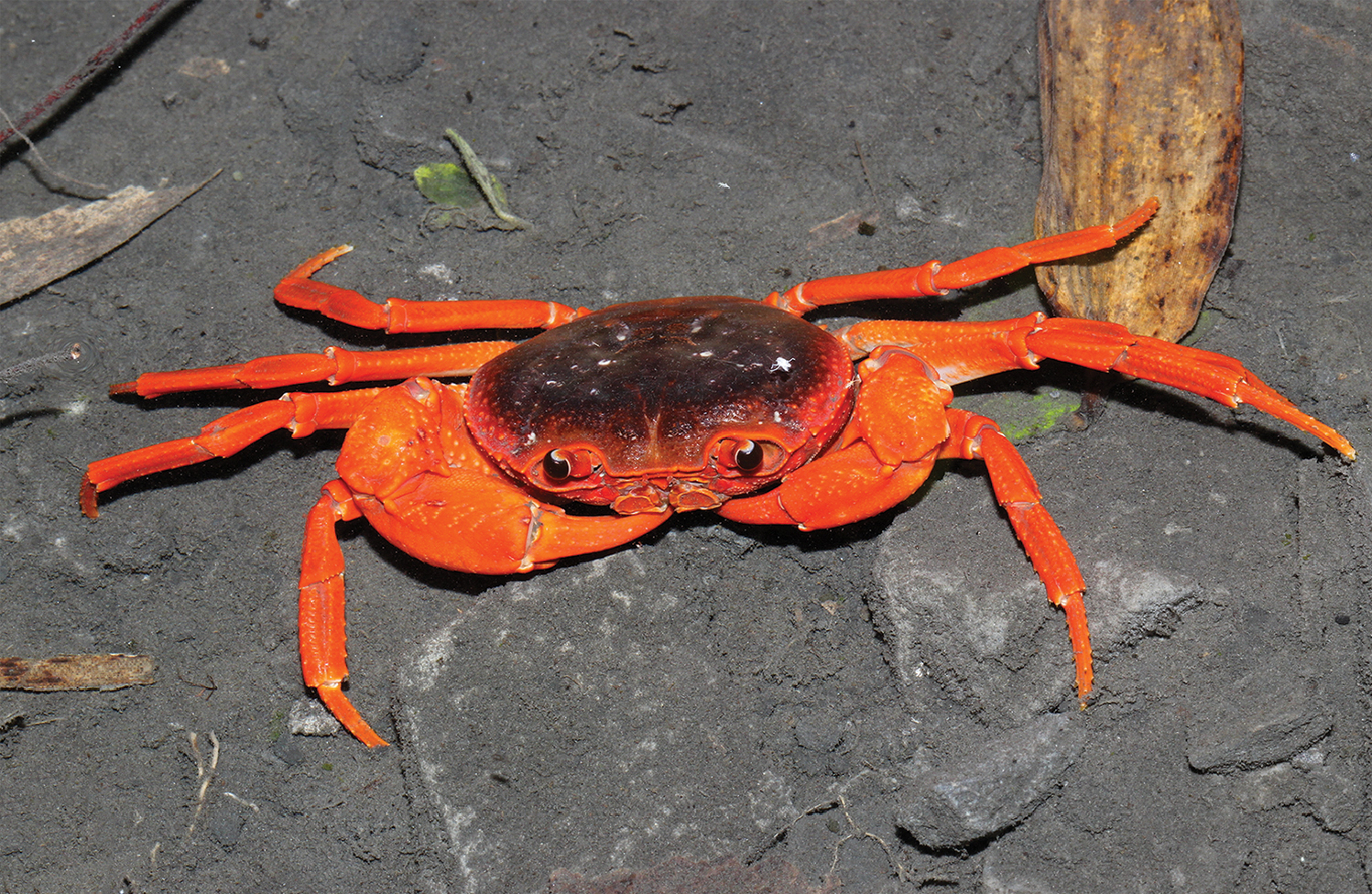
New crab species (Yuebeipotamon calciatile)Researchers have discovered a colourful new species of freshwater crab, which is also the first of an entirely new genus – the taxonomic rank above species – hiding in plain sight in a Chinese pet market.
There is a growing demand in China for eye-catching pet crabs from the south of the country, which fisherman are trying to meet by collecting and trading the crustaceans, often without knowing exactly what they are selling. These pet markets are often good starting points for scientists on the hunt for new species.read more

Giraffe genetic secret: Four species of tallest mammal identified

GiraffeIt is a famous, gentle giant of the African savannah, but the giraffe's genetics have just revealed that there is not one species, but four.
Giraffes have previously been recognised to be a single species divided into several sub-species.
But this latest study of their DNA suggests that four groups of giraffes have not cross-bred and exchanged genetic material for millions of years.
This is a clear indication that they have evolved into distinct species.
The study published in the journal Current Biology has rewritten the biology of Earth's tallest mammal.
The scientists say their findings could inform the conservation efforts for all four species of giraffe.
Conservation was the catalyst for this genetic research; the Giraffe Conservation Foundation asked the team to carry out genetic analysis of giraffes in Namibia.
The foundation wanted to understand the genetic differences between different giraffe populations, to see how the animals might be affected if different subspecies were mixed together when animals were moved into protected areas.read more

Saturday, 3 September 2016

New species of snake discovered in Madagascar by a team of researchers has been named ghost snake

New-species-of-snake-discovered-in-Madagascar-by-a-team-of-researchers-has-been-named-ghost-snake---indialivetoday A new species of snake discovered in Madagascar by a team of researchers has been named “ghost snake” for its pale grey colour and elusiveness.
The ghost snake was found within the Ankarana National Park in northern Madagascar in February 2014.
The snake is part of a common group of snakes called Madagascarophis, or cat-eyed snakes, named for the vertical pupils often found among them. They are active in the evening or night, the researchers said.
“None of the other snakes in Madagascarophis are as pale or have this distinct pattern,” said lead author Sara Ruane, post-doctoral researcher at the Louisiana State University’s Museum of Natural Science, US.
The team studied the snake’s physical characteristics that includes counting all of the scales on its belly, its back, including how many scales touch the eye and the number of scales on the upper and lower lips.
They also extracted DNA from tissue samples of the ghost snake and the previously found Madagascarophis -READ MORE

200 million-year-old intact skull of a new species of pterosaur is found in Patagoni

Scientists have announced the discovery of a new species of pterosaur from the Patagonia region of South America. Pictured is an artist's impressionĀ Scientists have discovered a new species of 200-million-year-old pterosaur from the Patagonia region of South America.
Remarkably, the brain case of the flying reptile was well preserved, offering scientists a new look at the pterosaur's brain anatomy.
The researchers have named this new species 'Allkauren koi' from the native Tehuelche word 'all' for 'brain', and 'karuen' for 'ancient'.read more