Saturday, 19 December 2015

200-year-old fossil mystery resolved

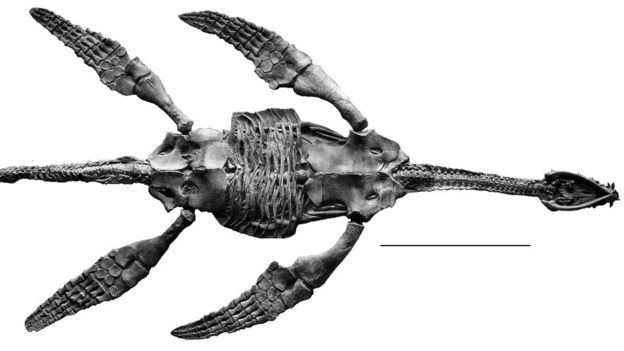
A virtual model of the reptile was constructed from a German plesiosaur known as MeyerasaurusScientists have reconstructed how an ancient reptile swam in the oceans at the time of the dinosaurs.
Computer simulations suggest the plesiosaur moved through the water like a penguin, using its front limbs as paddles and back limbs for steering.
The creature's swimming gait has been a mystery since bones of the first known specimen were dug out of a Dorset cliff 200 years ago.
The plesiosaur was discovered by the fossil hunter Mary Anning in 1821.
At the time even the name dinosaur had not been invented.
A scientific paper unveiling Anning's find a few years later raised the question of how the marine creature swam, given its unusual pairs of wing-like flippers.
The debate has continued until today, with a computer simulation based on a Jurassic fossil specimen providing evidence in favour of penguin-like motion-READ MORE AND WATCH VIDEO ON BBC LINK-http://www.bbc.co.uk/news/science-environment-35115195

Saturday, 12 December 2015

Synophis zaheri: New Species of Fishing Snake Found in Ecuador

The newfound species, named Synophis zaheri, is a small-sized, non-venomous snake with a slender body and head distinct from neck.
Synophis zaheri. Image credit: Pyron R.A. et al.“The species is named after the preeminent Brazilian herpetologist Hussam El-Dine Zaher, for his innumerable contributions to South American herpetology and snake systematics,” Dr Pyron and his colleagues explained in a paper that was published last week in the journal ZooKeys.
Synophis zaheri measures only 14 inches (36 cm) in length. Its eyes are large and bulbous, making up for more than a third of its head.
“Being black in color, it is hard to tell the pupil and the iris apart,” the scientists said.
“While the upper part of the body is grayish-brown with an iridescent sheen, the abdominal side stands out with its yellowish-white coloration.”READ MORE-http://www.sci-news.com/biology/synophis-zaheri-new-species-fishing-snake-ecuador-03495.html

New Plant Bug Genus With Four New Species Identified In Australia

The diverse family of plant bugs (Miridae) just got a little bigger. Researchers from the University of California, Riverside, recently discovered a new genus of plant bug and four new species hidden in Australia.READ MORE http://www.natureworldnews.com/articles/18680/20151209/new-plant-bug-genus-four-species-found-australia.htm
Tarnished Plant Bug

Hualianceratops wucaiwanensis,Species of Ceratopsian Dinosaur Discovered in China

Life restoration of Hualianceratops wucaiwanensis. Image credit: Portia Sloan Rollings.This new dinosaur was a distant cousin of the famed ceratopsian dinosaurTriceratops and lived early in the Late Jurassic period, roughly 160 million years ago.
According to a study published this week in the journal PLoS ONE, the find is one of the oldest known of ceratopsians.
The remains of Hualianceratops wucaiwanensis – a partial skull and foot – were collected from the Shishugou Formation of the Junggar Basin, northwestern China.
Like Triceratops, the new species was a plant-eater. But it didn’t have horns and was about the size of a spaniel.
Hualianceratops wucaiwanensis walked on two legs and had ornamental texture on nearly all parts of the skull.-READ MORE -http://www.sci-news.com/paleontology/hualianceratops-wucaiwanensis-new-species-ceratopsian-dinosaur-china-03504.html

Hawaii: 74 new species of round-waisted beetle discovered living on Haleakalā volcano

More than 70 new species of beetle have been discovered on one of Hawaii's volcanoes. Researchers announced 74 new round-waisted beetles had been identified on Haleakala volcano, Maui Island, in the latest edition of ZooKeys.
James Liebherr from Cornell University, said the discovery shows how Haleakalā is a centre for biodiversity, with the beetles evolving far faster into new species than normal because of their isolation. The group – Mecyclothorax – came from just one single colonising species, with speciation (splitting into a new species) taking place regularly since it arrived on Maui.READ MORE-http://www.ibtimes.co.uk/hawaii-74-new-species-round-waisted-beetle-discovered-living-haleakal-volcano-1533039

Saturday, 5 December 2015

Which Fish Can Live Out of Water?

Some fish didn’t get the memo.
For Saturday’s Weird Animal Question of the Week, Ving Salcedo asked what type of fish can live without water for a small period of time. It turns out quite a few have a fin in both worlds.
Out of the Pool to Get Cool
Several fish are amphibious, meaning they can typically survive out of water,Andy Turko, of the University of Guelph in Ontario, Canada, says via email.
Turko co-authored a recent study on the mangrove rivulus, a fish that leaps on land when its tropical waters get too warm. (Related: "To Cool Off, This Fish Leaves the Water.")-READ MORE -http://news.nationalgeographic.com/2015/12/151205-animals-science-fish-walking-water-oceans/

Puffins and nightingales among 20 new species to join Red List of endangered British birds

The number of British birds whose numbers have declined to dangerously low levels now stands at more than a quarter of the native species in the UK, the latest survey from conservation groups has found. Puffins, curlews and nightingales are among the 20 species to have joined the Red List of endangered British birds, as rural development and overfishing continues to wreak havoc on the feathered population. The additions, which also include merlins, kittiwakes and white-fronted geese, bring the number of bird species on the “threatened” list that frequent the UK to 67 - 27% of the entire population of 244 species, and a significant increase on the 52-READ MORE -http://www.independent.co.uk/news/uk/puffins-and-nightingales-among-20-new-species-to-join-red-list-of-endangered-british-birds-a6757791.html