Saturday, 26 November 2016

Researchers' quest to identify freshwater fish parasites in Japan

Hiroshima University scientists have identified a new species of parasite infecting an invasive freshwater fish on the subtropical island of Okinawa, Japan. The results are part of a project to find parasites that have arrived in Japan with their non-native hosts and understand the role of parasites in natural ecosystems. Tracking parasites can be one scientific method to monitor ecosystem health and attempt to conserve biodiversity.
The project began in 2012 when one of the researchers was trying to fill some of his free time. Masato Nitta, now a second-year PhD student at Hiroshima University, recognized some invasive fish in the stream that runs through the campus of the University of the Ryukyus in Okinawa, Japan, the university that hosted his research team during their field studies.
"It was just for play, not for official study. I saw two of the invasive catfish and I decided to try to catch them and check what parasites they had because I was curious. When I put the parasites under the microscope, they looked a little bit strange. read more

Lepisiota dispatching Pheidole ant.

A team of scientists conducting a recent biodiversity survey in the ancient church forests of Ethiopia made an unexpected discovery -- a rather infamous ant species (Lepisiota canescens) displaying signs of supercolony formation. According to D. Magdalena Sorger, a post-doctoral researcher with the North Carolina Museum of Natural Sciences and a key member of the team, the discovery is significant for two reasons. First, supercolony formation in ants is rare, with documented cases of only around 20 species worldwide. Second, other species in the Lepisiota genus have recently made headlines as worrisome invasive species, one in South Africa's Kruger National Park and another that shut down Australia's Darwin Port for several days. The team's findings, were published inInsectes Sociaux in November.
In Ethiopia, forests frequently surround Orthodox churches, some of which are more than 1,500 years old. These forests range in size from only a few hectares to more than 400 (~1,000 acres) and can be considered relict oases within largely barren land and agricultural fields. While L. canescens is native to the -read more

New salamander species are very tiny, very rare

Researchers report three new species of the world’s smallest salamander from the remote mountains of Oaxaca, Mexico. They also warn that the rare creatures are already in danger of dying out.
The three new species are from the enigmatic genus Thorius, the adults of which are smaller than a matchstick. They are, in fact, the smallest four-legged tailed organism on Earth, and their miniaturized bodies are highly unusual for vertebrates, with structures for feeding being among the most prominent.
Although once extremely abundant, populations of Thorius have declined precipitously over the last 30 to 35 years, and living Thorius are now rarely found in nature. The findings underscore the large number of amphibian species that remain to be discovered and formally described, and the need to find and save them before they are lost.
“Salamanders of the highlands of Mexico are closer to extinction than any other on Earth,” says David Wake, one of the coauthors of a paper about the new species in the journal PeerJ. “The main factors are habitat conversion and new -read more

Yellow-bellied Greenbul

R-574-Yellow-bellied-Greenbul~A-Froneman_Claro1The sighting was confirmed by John Wesson of the Wildlife & Environment Society of SA (WESSA) and Birdlife Harties, who says this sighting is of particular interest and importance.
“One of Birdlife Harties’ members saw the bird in Schoemansville around May this year. Last week, another resident of Schoemansville spotted the bird. Karen van Huizen, a resident of Karel Street brought more good news when she confirmed that there are at least two birds and that they have bred in the area. This is a major find, as it means it is not an isolated occurrence of a bird passing through.”
The Yellow-bellied Greenbul with its loud, distinctive call is normally only found in the north eastern parts of the country, especially the Lowveld areas up into Zimbabwe, Mozambique and coming down the coastal areas to around Durban.
It was spotted in De Wildt about three times over a five-year period, and there have been odd sightings in Pretoria and Sun City before.
“As more and more members of the public take an interest in birds, it is likely that other unusual species like these will be found in our area far out of their normal range. This has been the case with a number of Lowveld species that  have moved all the way into Johannesburg, drawn by one of the largest manmade forests in the world,” says John.-read more

New spider discovered that disguises itself as a leaf

A new species of spider has been discovered with a novel way of keeping its presence under wraps. So subtle is the newly found creature that you could mistakenly pluck it from a nearby tree with no idea it was an arachnid until you had a handful of spider.
Rather than hanging out all day on a web the new spider instead disguises itself as a leaf. The masquerade is so convincing, the spider has even grown a ‘tail’ to mimic a stalk.
Matjaž Kuntner, of the Slovenian Academy of Sciences and Arts, came across the spider while in China’s Yunnan province.
With his fellow researchers, Dr Kuntner was shining his torch light at spider silk strands when he came across a patch of odd looking leaves.
“If there’s a web, there’s a spider,” he said.
Looks like a leaf. Is much worse. Picture: Matjaz Kuntner
Looks like a leaf. Is much worse. Picture: Matjaz KuntnerSource:Supplied
As they investigated, the team found what they suspected to be an entirely new type of spider and the first known variant to try its luck at pretending to be leaf.
“Better known in insects, plants, birds, and fish, masquerade in arachnids involves only a handful of spiders ... that resemble flowers, dead twigs, plant detritus, buds, bark, or bird droppings,” said Dr Kuntner in the Journal of Arachnology. “However, genuine leaf masquerade has not been known in arachnids.”
In order to look the full leaf, the spider bunches its legs tightly together so it doesn’t give the game away.read more

Saturday, 19 November 2016

Scientists have found a new species of spider in a Chinese rain forest. The species is the first of its kind to mimic a leaf, and researchers still aren't sure why the masquerade is used. The spider uses its silk to stick leaves to tree branches and then lurks among them, likely lying in wait for unsuspecting prey.

Scientists have found a new species of spider in a Chinese rain forest. The species is the first of its kind to mimic a leaf, and the researchers still aren't sure why.Scientists have found a new species of spider in a Chinese rain forest.
The species is the first of its kind to mimic a leaf, and researchers still aren't sure why the masquerade is used.
The spider uses its silk to stick leaves to tree branches and then lurks among them, likely lying in wait for unsuspecting prey.


Read more: http://www.dailymail.co.uk/sciencetech/article-3945304/The-strange-spider-species-looks-just-like-LEAF-Arachnid-lurks-trees-remained-hidden-years.html#ixzz4QT0y3hyc

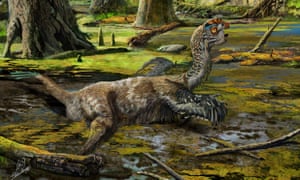
New species of 'weird bird'-like dinosaur discovered in China-Tongtianlong limosus

An artistic reconstruction, showing the last-ditch struggle of Tongtianlong limosus as it was mired in mud, interpretation for how the specimen was killed and buried.A farmer and construction workers in China have discovered the remains of a new species of bird-like dinosaur that appears to have died after getting stuck in the mud. The find, experts say, adds weight to the idea that such animals were thriving shortly before the mass extinction 66 million years ago.
Around the size of a sheep, with a beak, wings and a crest on its head, the flightless creature is thought to be a species of oviraptorosaur - a group of bird-like, feathered, toothless and short-skulled non-avian dinosaurs that were roaming the land in the period shortly before an asteroid slammed into Earth off the coast of Mexico, triggering the annihilation of swaths of life. 
“If you saw it alive you would just think it was a weird bird,” said Stephen Brusatte, a palaeontologist at the University of Edinburgh who, with colleagues in China, co-authored the research published in the journal Scientific Reports.read more