Sunday, 27 September 2015

Mississippi couple find 'strange animal' in toilet bowl

Ronald and Carol-Anne Morris found this mystery creature in the toilet at their Clinton, Miss., home. 16 WAPT News Jackson/YouTube video screenshot
CLINTON, Miss., Sept. 25 (UPI) -- A Mississippi couple returning from their honeymoon shared pictures of a mysterious "strange animal" they discovered in the bowl of their toilet.
Carol-Anne and Ronald Morris said they had just returned from their honeymoon Sept. 18 when they looked into the toilet and beheld a bizarre sight.READ MORE

Saturday, 26 September 2015

New species of lizard found on Island

Expanded population: The Warwick lizard
A two-year conservation project studying Bermuda’s anoles has uncovered a new species as well as lifting the lid on how the lizard population has expanded across the Island.
The initiative was led by Florida International University’s James Stroud and Sean Giery from North Carolina State University.
The two research scientists worked alongside the Department of Conservation’s wildlife ecologist, Mark Outerbridge, to record the distribution of the three species of anoles in Bermuda.
The team’s work led to the discovery of a new species of anole, the Cuban brown anole, as well as providing groundbreaking data of how the other species’ populations had spread.
“We embarked on this project in an attempt to record the current distributions of all Anolis lizards and recorded range expansions that may have occurred,” Mr Stroud said.READ MORE

Fossils of new duck-billed, plant-eating dinosaur found in Alaska

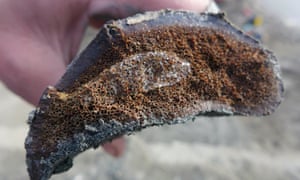
A sample of frozen bone is found after researchers excavated it from the Liscomb Bed in the Prince Creek Formation near Nuiqsut, Alaska.
Fossils from a unique plant eating dinosaur found in the high Arctic of Alaska may change how scientists view dinosaur physiology, Alaska and Florida university researchers have said.
A paper published on Tuesday concluded that fossilized bones found along Alaska’s Colville river were from a distinct species of hadrosaur, a duck-billed dinosaur not connected to hadrosaurs previously identified in Canada and the Lower 48 states.
It’s the fourth species unique to northern Alaska. It supports a theory of Arctic-READ MORE

Inside Walton Ford’s Brutal World of Man and Beast

READ MOREPARIS — Sometime during the summer of 1764 in the Haute-Loire region of France, a wolf-like creature attacked and killed as many as 200 peasants, often lone shepherdesses, savagely ripping out their throats. The animal proved impossible to trap; landowning nobles (the only ones with guns) failed to halt the killings and pacify the population. The animal soon acquired a name — “The Beast of Gévaudan” — and rampaged through the French psyche.
The dramatic narrative of Gévaudan served as inspiration for the artist Walton Ford’s exhibition here at the Musée de la Chasse et de la Nature (Museum of Hunting and Nature), which runs until Feb. 14.
“Aristocratic hunting traditions gone wrong,” he said in an interview by phone from New York. “Brutal killings that went unanswered; a mysterious beast turned into cryptozoology — animal hysteria.” While Mr. Ford has previously exhibited in Europe, notably “Walton Ford: Bestiarium” at Berlin’s Hamburger Bahnhof in 2010, the Paris show is the artist’s first-

Wednesday, 23 September 2015

Rats as big as cats! Binmen say they are being chased by huge foot-long rodents who show no fear of humans

Binman Ben Landricombe, 34, says he discovered this enormous rat while working in Plymouth, Devon
A team of binmen say they are being terrorised by a new breed of enormous foot-long rats which show no fear of humans and have even chased them during their rounds.
Feasting on rubbish, the rodents have grown bigger, more fearless and are more aggressive than ever before, according to refuse worker, Ben Landricombe, 34.
Mr Landricombe, who caught one of the massive rats in Plymouth, Devon, said he had even had to take cover when the animal went for him.   
He had discovered the creature scurrying behind a skip, and said it showed no fear of him as he cornered it.
'This latest one is over a foot long I reckon,' said Mr Landricombe, a street and refuse collector for Plymouth City Council.
'It is huge but I have seen this size and possibly even bigger in the last couple months.
'They are definitely getting bigger.
'Also they are not afraid of you as they used to be - I got chased by one.
'One came after me. I just went behind the bin and tried to shoo it away.
'It then went for me. They are certainly getting more vicious. They would never used to have done that.'
In its advice to households, Plymouth City Council recommends that people seek immediate action if they discover rats of any size in their home.

Saturday, 19 September 2015

The Kimberley death adder ..New species of deadly 'sit-and-wait' snake discovered in Australia

The Kimberley death adder
Scientists have discovered a new species of deadly snake in Australia – the Kimberley death adder – adding to the nation’s world-beating list of venomous snakes.
The venomous orange-brown snake – a “sit-and-wait” predator – has diamond-shaped scales and remains camouflaged before ambushing passing creatures such as birds, frogs and lizards, or potentially humans. It inhabits the remote Kimberley region of north-west Australia.
The new species adds to the impressive list of poisonous creatures in Australia, which is believed to have 20 of the world's 25 most deadly snakes, including the entire top ten.
Death adders – which are typically found in Australia, as well as in Indonesia and Papua New Guinea – are among the world’s most poisonous snakes. READ MORE

Cute' Dinosaur Found In Montana May Be A New Species

Ferocious"? Sure. "Man-eating"? In some cases, it's not hard to imagine. But "cute"? That's not a word that usually comes to mind when talking about dinosaurs.  
Yet that's how a possible new species of dinosaur is being described by researchers at the Rocky Mountain Dinosaur Resource Center in Woodland Park, Colorado. They unveiled a model of the creature, which resembles a tiny Triceratops-like dinosaur known as an Avaceratops, on Wednesday. READ MOREhttp://www.huffingtonpost.com/entry/new-dinosaur-species-triceratops-ava_55fc51d8e4b08820d9187cab