Sunday, 30 November 2014
Fears over the future of North Sea dolphins despite numbers staying stable
THE population of bottlenose dolphins in the North Sea is still listed as vulnerable, according to conservationists.
The sea off Scotland's east coast is home to about 200 bottlenose dolphins which draw around £4 million for the local tourist-driven economy.
They are the world's most northerly bottlenose dolphins and the European Union (EU) has designated the Moray Firth as a special area of conservation (SAC) to protect the species.
Scottish Natural Heritage (SNH) must report on their condition every six years and an interim report ahead of the next full publication in 2018 indicates that the population has remained stable over the last quarter of a century. Photographs and markings on the dolphins' fins indicate 102 individuals used the SAC in summer 2011, rising to 112 in 2012 and falling to 94 in 2013.
Long-term trends since 1990 indicate the numbers appear to be stable but the population is still considered to be vulnerable, SNH said.
Morven Carruthers, from SNH's marine team, said: "Dolphins in the Moray Firth SAC have been the focus of intense research for many years now and over that time the numbers using the SAC appear to have remained stable. This is a tribute to the people, organisations and relevant authorities around the Moray Firth."

Are seals mutilating and killing porpoises? Scientists investigate
 A gruesome series of killings has left porpoises stranded on the shores along the North Sea, and scientists now think they have a culprit: gray seals.
Turns out those adorable gray seals aren’t so cuddly after all. The findings, described in the Proceedings of the Royal Society B, reveal a disturbing trend that could potentially alter the ecology of harbor porpoises.
Related story: Bats use sonar jamming to steal food
Related story: Bats use sonar jamming to steal food
Amina Khan
Harbor porpoises, formally known as Phocoena phocoena, have been washing up along the coasts of the southern North Sea in Europe, with deadly wounds whose origins were a mystery. Were the-READ MORE-http://www.latimes.com/science/sciencenow/la-sci-sn-seals-mutilating-killing-porpoises-study-20141128-story.html-
A gruesome series of killings has left porpoises stranded on the shores along the North Sea, and scientists now think they have a culprit: gray seals.
Turns out those adorable gray seals aren’t so cuddly after all. The findings, described in the Proceedings of the Royal Society B, reveal a disturbing trend that could potentially alter the ecology of harbor porpoises.
Related story: Bats use sonar jamming to steal food
Related story: Bats use sonar jamming to steal food
Amina Khan
Harbor porpoises, formally known as Phocoena phocoena, have been washing up along the coasts of the southern North Sea in Europe, with deadly wounds whose origins were a mystery. Were the-READ MORE-http://www.latimes.com/science/sciencenow/la-sci-sn-seals-mutilating-killing-porpoises-study-20141128-story.html-
Saturday, 29 November 2014
RETURN OF THE MAMMOTH?
Yet again the persuit of cloning a Mammoth appears on t.v.This time via a documentary called WOOLLY MAMMOTH ON C4 OR 4od.This will give you an insight on how cloning techniques could see the return of the MAMMOTH.Made possible via a corpse of this creature called BUTTERCUP,a very well preserved MAMMOTH found in SEBERIA,RUSSIA,Last year.O NE OF DOING THIS IS TO 1-REMOVE NUCLEUS FROM EGG OF A FEMALE ASIAN ELEPHANT.2 INSERT A SKIN CELL FROM A MAMMOTH INTO EGG.3 IMPLANT THE EMBRYO INTO A ASIAN ELEPHANT THEN WAIT 2 YEARS.Dont hold out much hope as more science fiction then fact.
Brown bears return to Chernobyl after a century away
 Scientists have captured what is believed to be the first photographic evidence of brown bears within the Chernobyl Exclusion Zone (CEZ).
Camera traps, used by a project assessing radioactive exposure impacts on wildlife, recorded the images.
Brown bears had not been seen in the area for more than a century, although there had been signs of their presence.
The exclusion zone was set up after an explosion at the Chernobyl nuclear power plant in Ukraine in April 1986.
"Our Ukrainian colleague, Sergey Gashchak, had several of his camera traps running in one of our central areas over the past few months in order to start to get a feel for what (wildlife) was there," explained project leader Mike Wood from the University of Salford.
He told BBC News that data retrieved from one of the cameras in October contained images of a brown bear.
"There have been suggestions that they have existed there previously but, as far as we know, no-one has got photographic evidence of one being present on the Ukrainian side of the exclusion zone," Dr Wood said.
"We are basically working on the assumption that as you move people out of the equation and human pressure and disturbance is removed, then any animals that have a corridor into the exclusion zone find they are suddenly away from the pressures and dangers presented by people."
Following the April 1986 explosion - described as the world's worst nuclear power plant accident - more than 110,000 were moved from their homes as a 30km-radius exclusion zone was established around the damaged nuclear reactor.
In the subsequent years, the area has provided a valuable source of data for scientific research into the impact of radioactive contamination-READ MORE-http://www.bbc.co.uk/news/science-environment-30197341
Scientists have captured what is believed to be the first photographic evidence of brown bears within the Chernobyl Exclusion Zone (CEZ).
Camera traps, used by a project assessing radioactive exposure impacts on wildlife, recorded the images.
Brown bears had not been seen in the area for more than a century, although there had been signs of their presence.
The exclusion zone was set up after an explosion at the Chernobyl nuclear power plant in Ukraine in April 1986.
"Our Ukrainian colleague, Sergey Gashchak, had several of his camera traps running in one of our central areas over the past few months in order to start to get a feel for what (wildlife) was there," explained project leader Mike Wood from the University of Salford.
He told BBC News that data retrieved from one of the cameras in October contained images of a brown bear.
"There have been suggestions that they have existed there previously but, as far as we know, no-one has got photographic evidence of one being present on the Ukrainian side of the exclusion zone," Dr Wood said.
"We are basically working on the assumption that as you move people out of the equation and human pressure and disturbance is removed, then any animals that have a corridor into the exclusion zone find they are suddenly away from the pressures and dangers presented by people."
Following the April 1986 explosion - described as the world's worst nuclear power plant accident - more than 110,000 were moved from their homes as a 30km-radius exclusion zone was established around the damaged nuclear reactor.
In the subsequent years, the area has provided a valuable source of data for scientific research into the impact of radioactive contamination-READ MORE-http://www.bbc.co.uk/news/science-environment-30197341
FIVE new-species-found-under-our-noses
If you want to discover a new species, try going for a walk. You might well spot something.
While around 1.2 million species of living organisms have been identified and described, there are probably far more waiting to be found. One recent study estimated there are another 6.8 million animals, 567,000 fungi and 90,000 plants awaiting discovery. New species are being found at a rate of 15,000 to 20,000 per year.
While most are found in remote environments like rainforests, caves and the ocean depths, other discoveries happen much closer to home. Here are five examples of new animals, plants and fungi found living under our noses.-READ MORE-http://www.bbc.com/earth/story/20141124-new-species-found-under-our-noses
ascetoaxinus quatsinoensis-New clam species found off of B.C.'s coast
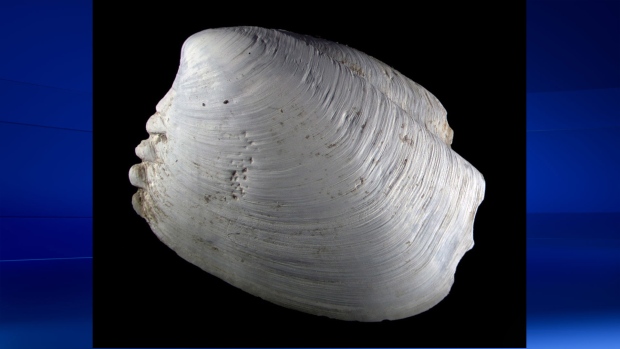 VICTORIA -- Ten years after an unusually scalloped clam was dragged up from the ocean floor off northern Vancouver Island, the tiny mollusk is making waves in the research world.
Melissa Frey, curator of invertebrates at the Royal BC Museum, was cataloguing a number of species about four years ago when she noticed something different about the tiny clam.
"I looked at the unusual scalloping and I thought this was definitely special," she said in an interview Wednesday.
"It's unusual enough and I compared it to everything that has previously been described on the West Coast of North America ... and it didn't match up to anything that was there."
To the untrained eye, the clam doesn't look much different than others. It's the same chalky white colour as many other clams and about the same length and height as a walnut in the shell.
Frey asked for the opinion of Graham Oliver, a world expert on bivalves at the National Museum of Wales, who confirmed it was a new species.
The two recently co-wrote an article on the clam, which has been published in the journal Zootaxa.
Only one of the clams has ever been found, and she said researchers often don't like to publish new species descriptions based on one specimen.
"But in certain cases, when you're in a certain situation where the environment is so far away and it's not an area that we get to very often, and we don't know that much about the relative abundance of these animals.
Read more: http://www.ctvnews.ca/sci-tech/new-clam-species-found-off-of-b-c-s-coast-1.2121156#ixzz3KScOO275
A British paleontologist has discovered not one, but two new species of dinosaur while studying fossils in a Canadian museum. Dr Nick Longrich was examining fossilised bones from two horned dinosaurs, which had been kept in the Canadian Museum of Nature for 75 years. And he found that, while they had previously been classified as a species from Canada, they more closely resembled dinosaurs from the American south west - suggesting they are a new species. Read more: http://www.dailymail.co.uk/sciencetech/article-2849070/Fossils-reveal-TWO-new-species-dinosaurs-roamed-North-America-75-million-years-ago.
 A British paleontologist has discovered not one, but two new species of dinosaur while studying fossils in a Canadian museum.
Dr Nick Longrich was examining fossilised bones from two horned dinosaurs, which had been kept in the Canadian Museum of Nature for 75 years.
And he found that, while they had previously been classified as a species from Canada, they more closely resembled dinosaurs from the American south west - suggesting they are a new species.
Read more: http://www.dailymail.co.uk/sciencetech/article-2849070/Fossils-reveal-TWO-new-species-dinosaurs-roamed-North-America-75-million-years-ago.html#ixzz3KSbsglU3
Follow us: @MailOnline on Twitter | DailyMail on Facebook
Subscribe to:
Posts (Atom)