Sunday, 23 March 2014
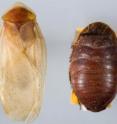
Thirty-nine new species of endemic cockroach discovered in the southwestern US and Mexico

New 'jellybean' spider species found on Queensland's Darling Downs

read moreScientists from the Queensland Museum have discovered two new species of goblin spiders on the state's Darling Downs.
Dr Barbara Baehr says her team discovered the Opopaea broadwater, also known as the jellybean goblin spider in Dalby.They also discovered the Leichhardteus badius, or reddish brown swift spider, while exploring a rainforest in the Bunya Mountains last year.
The museum says the genus name Leichhardteus was chosen to honour German explorer and scientist Ludwig Leichhardt, who came to Australia in 1842 to study wildlife
Saturday, 22 March 2014
ANZU WYLIEI-CHICKEN/OSTRICH LIKE DINOSAUR DISCOVERED
ANZU WYLIEI a new species of dinosaur discovered by U.S.A. scientists.ANZU WYLIEI is a bird like creature with a bony crest on top of a beaky head and a long lizard like tail.The dinosaur was identified by the partial remains of 3 skeletons found in NORTH and SOUTH DAKOTA.And it is believed this-
 fossil offers clues to how dinosaurs became extinct 66 million yeas ago.
CANCER IS IT OLDER THAN FIRST THOUGHT

Thought as a human skeleton from 1200bc was discovered riddled with it.The skull was the remains of a rich man who lived by the river Nile aged 35 years old. The skull was found in a SUDAN tomb by DURHAM UNIVERSITY ARCHAEOLOGY STUDENT MICHAELA BINDEN, cancer theories causes range from -smoke from wood fires,disease from parasites, genetic factors.
Wednesday, 19 March 2014
Stearns Bayou monster remains cryptozoological mystery
The first witnesses of the creature were Charles Cotton, Herman Nyland and Charles Shupe on Aug. 9.
“The sight they saw is described as that of a hideous-looking beast moving through the waters with a head like that of a hippopotamus,” the Tribune reported Aug. 13, 1909. “The body resembled a soft-shell turtle about 6 feet in diameter and it had a tail about 10 feet long. The under shell or belly of the beast gave out aread more
“The sight they saw is described as that of a hideous-looking beast moving through the waters with a head like that of a hippopotamus,” the Tribune reported Aug. 13, 1909. “The body resembled a soft-shell turtle about 6 feet in diameter and it had a tail about 10 feet long. The under shell or belly of the beast gave out aread more
New Species of Cave-Dwelling Spiders Found in China

If spiders creep you out, stay away from the caves of southwest China, where researchers have found five new species of spiders with armored undersides and four eyes.
The South China Karst, a UNESCO World Heritage Site, features expansive stone forests, huge sinkholes, natural bridges and underground caves. It was in the caves that the new spiders were found, by a group of researchers from the Chinese Academy of Sciences who have explored more than 2,000 caves in the area, according to a release. Their research has helped bring the total number of spider species in China from 2,300 to 4,300 in the past 10 years. (MORE: Threatened UNESCO World Heritage Sites)
The spiders belong to a group known as armored spiders, which feature a pattern that resembles body armor on their abdomens. Many of these spiders live in soil, but some, like the new species, prefer caves. Living in darkness can cause species to lose eyes over time, and indeed, two of the newread more
New species of praying mantis found

Nineteen new species of a tree-living praying mantis family have been discovered, tripling the group's diversity at a stroke.
The bark mantises from Central and South America were found in tropical forests and among specimens kept in museums.Many of the newly described species are known only from a few specimens collected before 1950 from locations now heavily impacted by agriculture or urban development.
"Based on this study, we can predict that mantis groups with similar habitat specialisation in Africa, Asia and Australia will also be far more diverse than what is currently known," said Dr Gavin Svenson, curator of invertebrate zoology at the Cleveland Museum of Natural History in the US.
"Many of these groups have never been studied other than by the scientists that originally described some of the species, which in some cases is more than 100 years ago. This is exciting because enormous potential exists for advancing our understanding of praying mantis diversity just by looking within our existing museum collections andread more
Subscribe to:
Posts (Atom)